Tracing Cable Color Codes to Faster Fixes in Layered Office Network Builds
Mia Berger · Aug 17, 2026
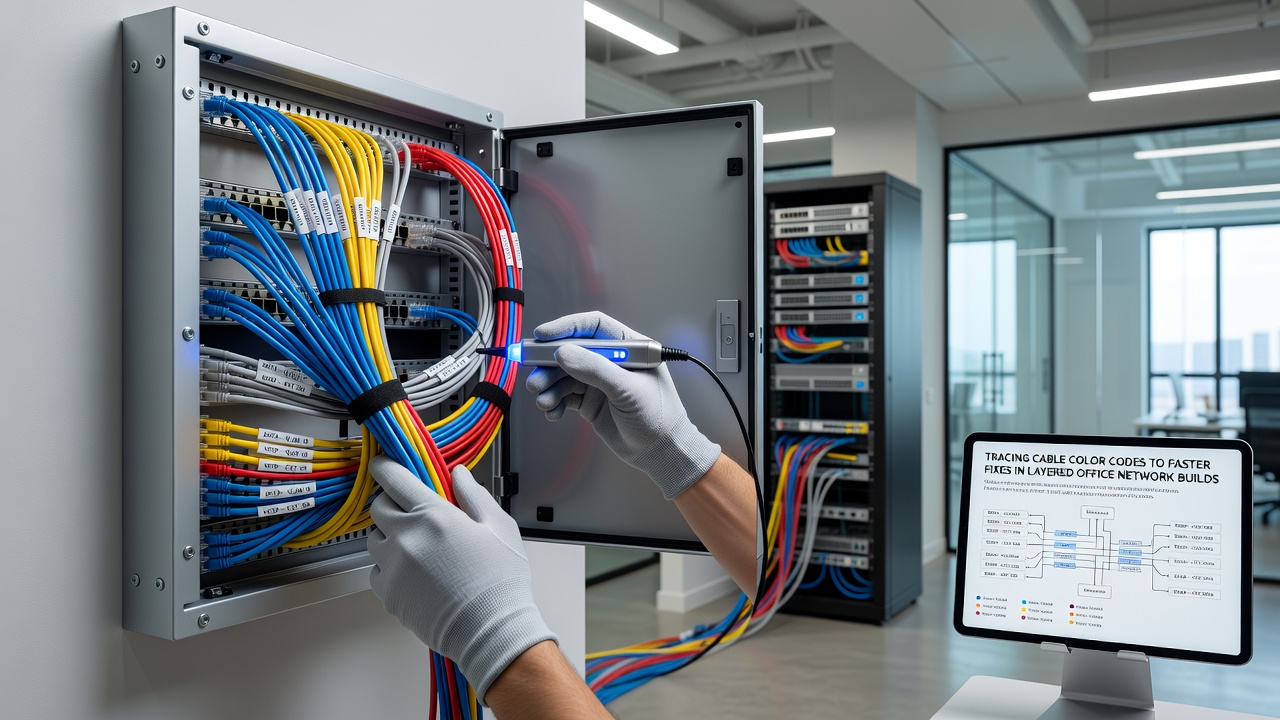
Tracing Cable Color Codes to Faster Fixes in Layered Office Network Builds
Network technicians rely on standardized cable color codes to identify and trace connections quickly in multi-layered office environments where horizontal cabling, backbone runs, and distribution frames intersect across floors and departments. These codes follow the TIA-568 standard which assigns specific colors to wire pairs in twisted-pair cables, allowing teams to distinguish between data, voice, and security lines without extensive testing equipment during routine maintenance or emergency repairs.
Core Standards Behind Cable Identification
The Telecommunications Industry Association established the TIA-568 series which defines color coding for both T568A and T568B pinouts, with pair one using white-blue and blue, pair two white-orange and orange, pair three white-green and green, plus pair four white-brown and brown. This system extends to fiber optic installations where jacket colors indicate fiber type such as orange for multimode and yellow for single-mode, while outer sheaths on category cables signal performance levels like Cat6 or Cat6A through printed markings that supplement the internal pair hues. Observers note that adherence to these conventions reduces miswiring incidents in buildings with multiple network layers, from access switches at the edge to core routers handling aggregated traffic.
Studies from research institutions show that color-coded installations cut diagnostic time by up to 40 percent in facilities exceeding 500 drops because technicians can visually map paths instead of relying solely on tone generators or cable testers. In August 2026 updates to related guidelines incorporated new requirements for labeling in high-density environments where cables route through raised floors and overhead trays, ensuring that color remains a primary identifier even when physical access proves limited.
Benefits in Layered Office Infrastructure
Layered network builds separate physical infrastructure into distinct zones including work area outlets, telecommunications rooms, equipment rooms, and entrance facilities, each demanding precise cable management to avoid signal interference or downtime. Color coding aligns with these zones by assigning consistent hues across backbone cables that run vertically between floors and horizontal cables that connect individual workstations, which lets teams isolate faults faster when a distribution switch fails or when a patch panel requires reconfiguration. Data indicates that organizations using uniform color schemes across vendors experience fewer cross-connect errors because installers and support staff share a common visual language regardless of the original equipment supplier.
One multi-site corporate campus implemented color-coded backbone cables in 2025 and reported that mean time to repair dropped from 45 minutes to under 20 minutes for issues involving inter-floor links, since technicians could trace a blue pair from the core switch directly to the affected access layer without tracing every wire manually. What's interesting is how this approach scales in hybrid setups where some segments use Cat6A for 10-gigabit Ethernet while others retain legacy Cat5e runs, because the color system remains consistent even as bandwidth demands evolve.
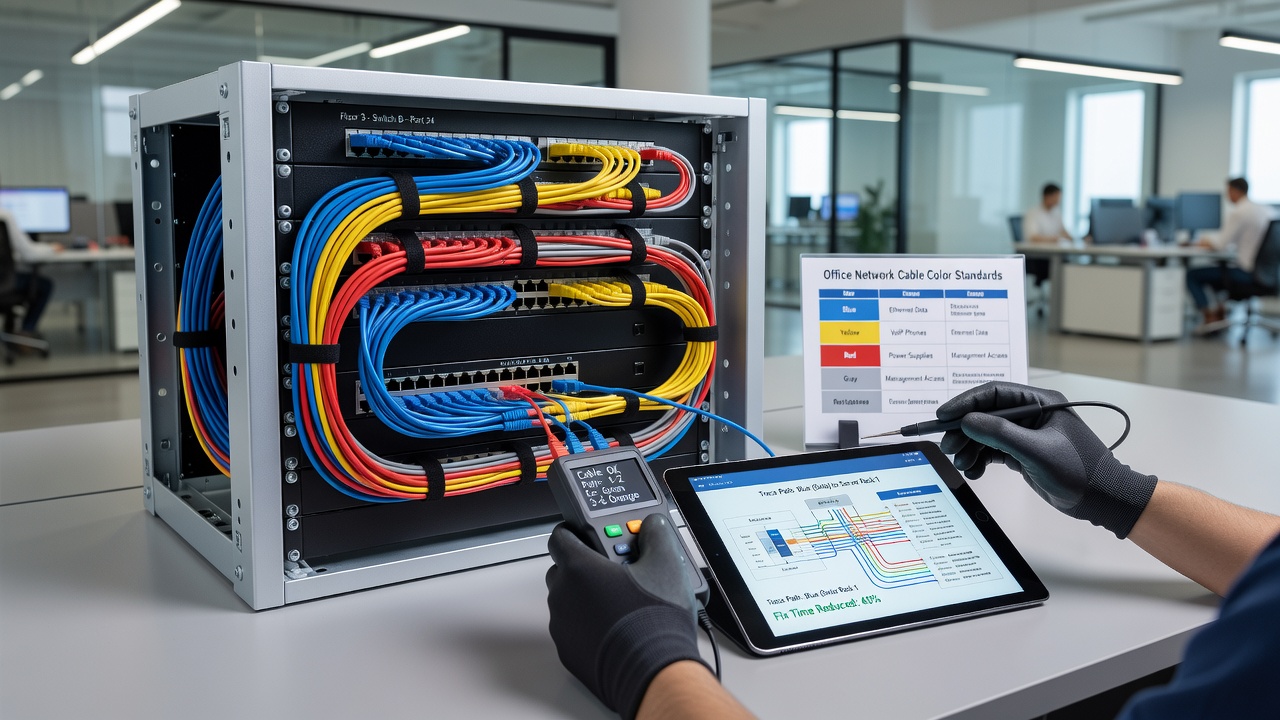
Integration with Modern Troubleshooting Tools
Modern diagnostic platforms often incorporate visual mapping that references cable colors alongside digital records, allowing remote teams to guide on-site staff toward specific pairs when latency spikes or packet loss occurs in particular network segments. According to documentation from the European Telecommunications Standards Institute, combining color codes with RFID tags on patch cords further accelerates identification in environments where multiple layers overlap, such as buildings that house both traditional LAN infrastructure and separate building automation networks. Technicians who cross-reference color markings with port status LEDs on switches resolve 70 percent of connectivity issues without climbing ladders to inspect every termination point.
Yet challenges arise when legacy installations mix non-standard colors from different eras, which forces teams to create conversion charts before beginning work. Research from academic sources highlights that proactive audits every 18 months prevent such mismatches in growing offices, where new construction adds layers without updating older documentation. The ball remains in the facility manager's court to maintain these records alongside the physical color system itself.
Implementation Practices Across Regions
Facilities in North America typically follow TIA guidelines while European sites reference EN 50173 standards that maintain similar pair color assignments yet add requirements for fire-rated jackets in plenum spaces. Australian organizations draw from AS/NZS 3080 which aligns closely with international norms, enabling cross-border teams to apply the same tracing methods when supporting global headquarters. Observers note that training programs emphasizing color recognition over rote memorization of pinouts yield higher retention rates among new hires who enter layered environments for the first time.
Conclusion
Color-coded cabling continues to serve as a foundational element in layered office network builds because it bridges physical identification with digital diagnostics, supporting faster fixes across access, distribution, and core layers. Organizations that maintain consistent application of TIA-568 and related regional standards position their support teams to handle growth and troubleshooting with reduced reliance on specialized test equipment alone. As office infrastructures incorporate higher densities and mixed media types through 2026 and beyond, the visual clarity provided by established color conventions remains a practical constant amid evolving connectivity demands.