Decoding Connectivity Thresholds That Trigger Proactive Component Replacements Across Distributed Computing Infrastructures
Anna Brooks · Aug 14, 2026
Decoding Connectivity Thresholds That Trigger Proactive Component Replacements Across Distributed Computing Infrastructures
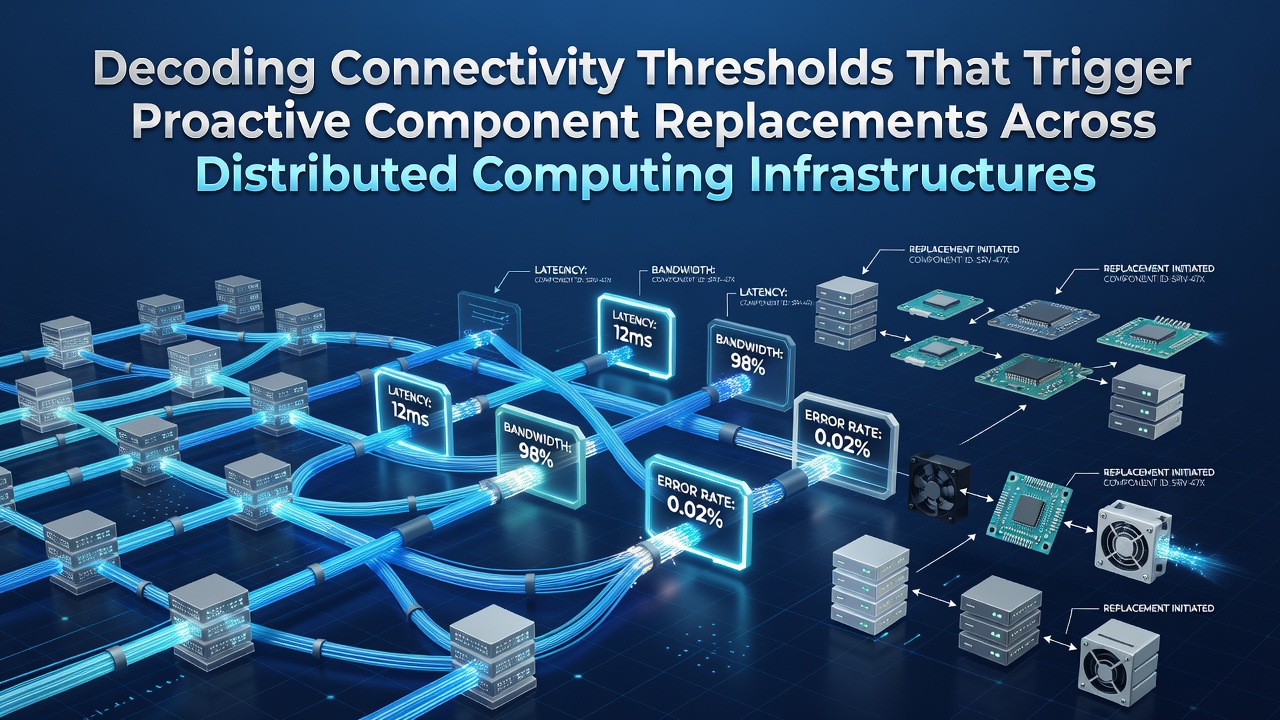
Connectivity thresholds in distributed computing infrastructures serve as measurable benchmarks that indicate when network performance metrics signal impending hardware degradation and necessitate component replacements before failures cascade across nodes. Researchers track packet loss rates exceeding 2 percent alongside latency spikes beyond 150 milliseconds as common indicators that prompt system administrators to schedule proactive swaps of network interface cards or switches. Data from multiple enterprise deployments reveals these patterns emerge consistently in environments spanning cloud regions and edge clusters where traffic volumes fluctuate daily.
Defining Key Threshold Metrics in Networked Systems
Bandwidth utilization crossing 85 percent sustained over 24-hour windows combined with jitter variations above 30 milliseconds often precedes physical layer faults in fiber optic links or router backplanes according to reports compiled by infrastructure operators. Studies from academic institutions show that error correction rates climbing past 5 percent per transmission cycle correlate strongly with aging transceivers and prompt early intervention protocols. Observers note that these metrics integrate into centralized monitoring platforms which aggregate telemetry from thousands of endpoints simultaneously while filtering noise from transient congestion events.
Threshold calibration varies by workload type yet follows patterns documented in industry analyses where high-performance computing clusters trigger alerts at lower tolerance levels than general-purpose virtual machine farms. Teams responsible for multi-site setups adjust these values seasonally to account for increased demand during peak business cycles without triggering unnecessary replacements.
Mechanisms Linking Connectivity Data to Replacement Decisions
Automated orchestration tools parse real-time connectivity feeds and cross-reference them against historical failure datasets to generate replacement recommendations that minimize downtime windows. When signal-to-noise ratios drop below established baselines for more than four consecutive hours the systems flag affected components for preemptive removal during scheduled maintenance periods. Evidence from large-scale rollouts indicates this approach reduces unplanned outages by integrating predictive models that factor in temperature readings and power draw alongside network statistics.
One documented workflow involves edge devices in remote facilities where connectivity degradation detected through heartbeat packet failures above 10 percent leads to automated tickets routed to field technicians equipped with replacement inventory. Such processes align with standards outlined in publications from organizations like the National Institute of Standards and Technology which emphasize proactive lifecycle management in distributed architectures.

Implementation Across Hybrid and Multi-Cloud Environments
Enterprises operating across AWS, Azure and private data centers apply unified threshold frameworks that normalize metrics from disparate vendor APIs into comparable scores. Research indicates that packet retransmission counts surpassing 1,000 per million packets serve as reliable triggers for swapping optical modules in interconnect fabrics regardless of underlying provider. In August 2026 several reports highlighted expanded adoption of these methods following updates to interoperability guidelines issued by European telecommunications bodies.
Integration with configuration management databases allows teams to map connectivity events directly to asset serial numbers enabling precise identification of aging hardware batches that exhibit similar degradation curves. This mapping supports bulk replacement campaigns that optimize logistics across geographically dispersed sites while maintaining service level agreements for latency-sensitive applications.
Case Examples from Operational Deployments
Financial services firms running distributed trading platforms have reported that monitoring round-trip times above 75 milliseconds across inter-site links prompted replacements of core routers ahead of quarterly earnings releases. Similar patterns appear in healthcare networks where diagnostic imaging transfers suffer when connectivity thresholds breach defined limits leading to scheduled hardware refreshes coordinated with software update cycles. Those overseeing satellite-dependent remote infrastructures observe seasonal rhythms in user activity that further refine threshold sensitivity settings to avoid false positives during low-traffic periods.
Academic studies published through university research portals demonstrate how machine learning classifiers trained on months of connectivity logs achieve over 90 percent accuracy in predicting component end-of-life based solely on network-derived features without requiring physical inspection.
Conclusion
Connectivity thresholds function as foundational signals within distributed computing infrastructures that enable timely proactive component replacements when metrics such as latency packet loss and bandwidth utilization cross predefined limits. Organizations leverage aggregated telemetry and historical datasets to calibrate these triggers across diverse environments while aligning decisions with established standards from bodies like the National Institute of Standards and Technology. Continued refinement of these approaches supports stable operations as infrastructures scale and incorporate new hardware generations.