24 Jun 2026
Advisors' Scheduling Choices and Their Effects on Protection and Storage Coordination in Scaling Operations

Tech advisors face constant decisions about when to slot in security updates, maintenance windows, and data migrations, and those timing choices ripple through protection layers and storage systems as operations expand. Research indicates that misaligned schedules often create gaps where vulnerabilities linger longer than necessary while storage resources sit underutilized or become fragmented across growing infrastructures.
How Scheduling Decisions Shape Daily Operations
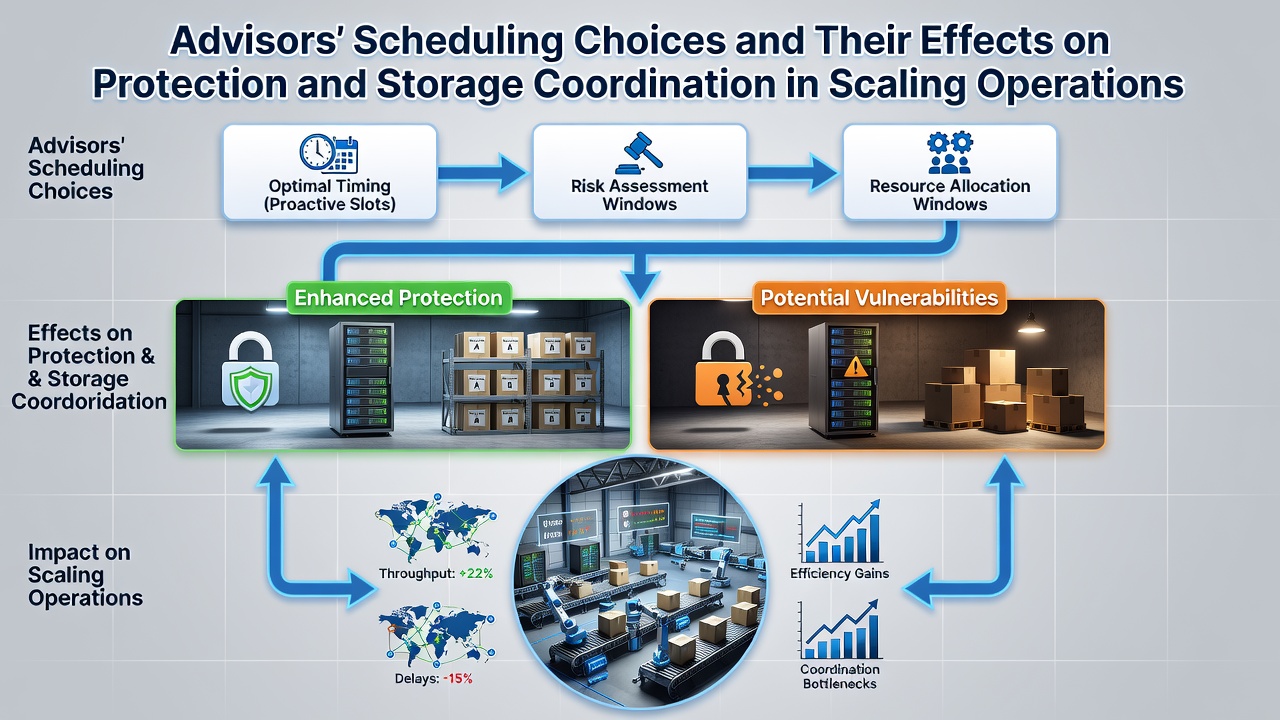
Advisors typically balance client availability with system downtime requirements, yet the order and spacing of tasks determine whether protection protocols activate before or after storage synchronization occurs. Data from enterprise deployments shows that clustering firmware updates into narrow windows can overload bandwidth, which delays encryption key rotations and leaves temporary copies of sensitive files exposed during scaling phases. Observers note that spreading assessments across multiple days allows storage coordinators to verify backups in sequence, reducing the risk of incomplete snapshots when new nodes come online.
Protection Mechanisms Under Time Pressure
When advisors push cybersecurity patches into the same blocks reserved for hardware scaling, protection tools sometimes compete for the same compute cycles that storage replication processes require. Studies from distributed system analyses reveal that sequential scheduling, where vulnerability scans precede capacity expansions, maintains consistent encryption standards across newly added volumes. In contrast, parallel approaches can fragment audit logs, making it harder to trace whether every device cluster received the latest access controls before traffic volumes increased.
June 2026 brought updated guidelines from the Australian Cyber Security Centre that emphasize staggered rollout timelines for organizations managing hybrid cloud environments. Those recommendations highlight how early coordination between security teams and storage architects prevents cascading failures when scaling multi-site operations.
Storage Coordination Challenges During Growth Phases
Scaling operations demand precise alignment between when data gets tiered to new storage arrays and when protection policies refresh their rulesets. Evidence from large-scale migrations indicates that advisors who schedule deduplication routines immediately after expansion windows achieve better compression ratios, because fresh data blocks have not yet been locked by concurrent security scans. Those who've examined post-scaling audits find that delayed storage coordination often results in duplicated encryption overhead, raising both costs and latency for end users accessing distributed resources.
Case Examples from Enterprise Deployments
One logistics firm that expanded its regional data centers in 2025 discovered through post-implementation reviews that scheduling all perimeter firewall changes before storage rebalancing reduced breach surface area during the transition. Another organization handling healthcare records aligned its quarterly compliance checks with incremental storage additions, which allowed real-time verification that every new volume inherited the correct retention and access policies without manual intervention.
Figures from industry reports demonstrate that organizations adopting buffer periods between protection tasks and storage operations experience fewer synchronization errors when node counts double within a single quarter. Those patterns appear consistently across sectors where advisors document decision trees that prioritize encryption verification immediately after capacity increases.
Integration of External Research Findings
Analyses published by the European Union Agency for Cybersecurity outline how timing mismatches between update cycles and data replication windows contribute to incomplete protection coverage during rapid scaling. Additional work from Canadian research institutions on distributed systems shows measurable improvements in storage integrity when advisors insert dedicated coordination checkpoints between security and capacity milestones.
These documented approaches rely on shared calendars that surface conflicts early, allowing teams to adjust sequences rather than forcing reactive fixes after scaling events conclude. The reality is that clear handoff points between protection and storage functions become more critical as the number of sites and devices multiplies.
Conclusion
Advisors' choices about task ordering and spacing directly influence how effectively protection measures and storage systems stay synchronized throughout scaling cycles. Organizations that map these dependencies in advance maintain stronger continuity, while those that treat scheduling as an afterthought encounter repeated friction points that compound as operations grow. Continued attention to these coordination patterns supports stable expansion without sacrificing security posture or data accessibility.